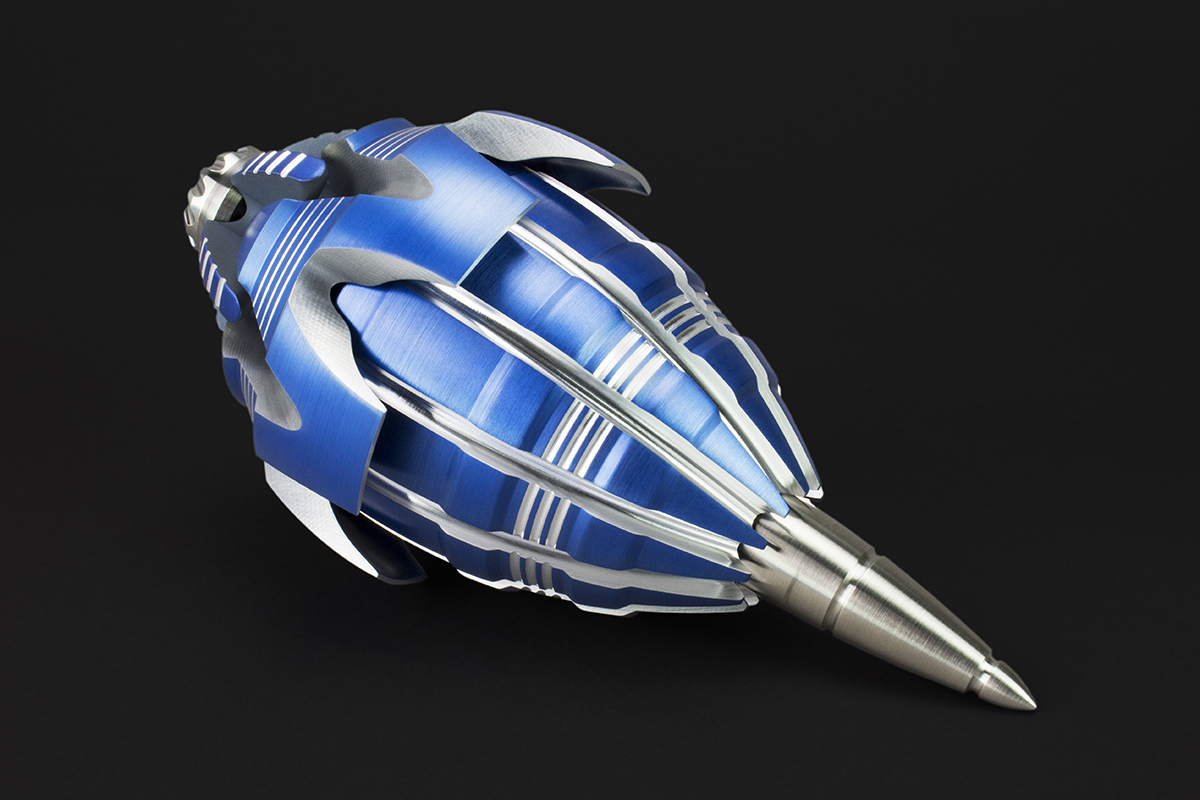
This work is loosely based on a very common type of automatic knife called an "OTF" or "Out The Front" knife. Sort of like the much more popular switchblade, it is characterized by a spring loaded assembly that extends and retracts the blade through the top of the knife by means of actuating a small lever.
In the case of this kinetic sculpture project, the center object moves both "Out the Front" and "Out the Back". Surely some crazy knife designer has made a knife like this somewhere at some time, but in any case, I am calling this work the "OTFB". The B stands for more than one thing, but I have given you the most obvious one.
The edition saw me experimenting with a wide variety of color and material combinations coupled with small tweaks to the original design. Below is the full catalogue of the entire run.
Red anodized aluminum with black powder coat.
Purple anodized aluminum with black powder coat
Green anodized aluminum with white powder coat
Blue anodized aluminum, re-machined to expose raw aluminum.
Brass with red powder coating
Brass with Black powder coating.
Teal anodized aluminum with yellow powder coating
black anodized aluminum with green powder coating
Deep copper anodized aluminum with blue powder coating
Purple anodized aluminum with blue powder coating
And of course, no edition would be complete without at least one All stainless steel version. In this case, I made a pair of them.
It was a long and fascinating ordeal to produce all of these variations, but all good things must come to a close. ...So that new good things can begin of course.
Earlier this winter, I took a rare month from my normal routine in order to prototype, experiment, and just generally play around with a wider range of ideas than usual. Some of the experiments from this month of tinkering may never see the light of day. But today I have decided to let one of those ideas out of the bag.
Although I suspect some of you might have been expecting this piece, I introduce the MG-2.
For those unfamiliar, please see my earlier post for the MG-1
This piece is a perfect example of how seemingly small changes to a design can create many unforeseen challenges. It is why I so often find myself saying if you don't get your hands dirty from time to time, it is very difficult to be a good artist or designer. That is because I have found over and over again that it is the "work" that leads to "inspiration" and not the other way round.
When I was doing the initial sketches on this piece, I had
some vague idea of how I wanted to iterate on the original
MG1 piece. I knew I wanted it to be longer
and narrower so it would fit in the hand a certain way and I had a rough outline of a shape I liked.
However the first draft I made was quite plain. It was
obvious that something was missing and that the idea just needed more time to
mature, that I needed to just think on it a bit longer. But as long as I
waited and try as I might, I could not “think” of what was missing.
I tried, through sketches, to add a lot of trivial decorative elements, adding notches
and details that had no reason to be there other than to try and make things
“look” a certain way. No matter how many renders I did, I just
couldn’t hit on anything that clicked for me. All of the design decisions I was
making felt arbitrary and unnecessary.
So eventually, after months of this off and on thinking and
sketching, I decided to just“make”
a rough version of what I already had. Just something I could hold in the real
world. Maybe it would speak to me and tell me what it needed.
I had no intention
of this first work being the final form, I just wanted to see what might emerge
from the process of fabricating the parts. Whether the challenges involved in
the physical building of the thing might shake something loose.
I reasoned, as I always do, that there are
some things you just can’t get from staring at a computer screen and rubbing your
chin. And boy was I right in this
case.
For such a simple shape, it turned out to be a particularly
difficult fabrication process. There were an unusually high number of problems that arose during set up
and machining.
They were things that absolutely needed to
be accounted for, and they immediately highlighted the constraints I was working with and helped me focus on the design choices that were most important.
From there, the piece practically designed
itself because I was able to properly weigh the opportunities and costs each of my design choices presented.
So while I was hopelessly stuck in the drawing room, addressing
real issues in the real world quickly led me down a path of necessity that
also proved to be a visually elegant and meaningful aesthetic solution.
If you are interested in the specifics of some of the challenges I encountered, the embedded video above addresses quite a bit of that. Better than me writing a novel about it.
So, as has become customary, a small edition of the MG-2 seems appropriate.
For those interested, I will open a short pre-order for this series on
March 19th, 11 AM EST.
The sign up list will be open for 24 hours Only!
I expect to begin production early April.
So check back at this space in a week and I will post the link to the sign up with all the details and pricing info then.
Today, I am pleased to reveal the second installment in what is becoming a "machined vessel" series.
This design project is yet another collaboration with my friends at Revolvemakers, and has been in the works since the release of our original NHVB Vessel. The idea for this series was spawned by my ongoing interest in how other industrial processes have transitioned from the factory floor into various niche and fine art traditions.
As many of you know, I have been thinking a lot about traditional forms within the various studio craft movements. Practices such as glasswork, woodwork, ceramics and stone are interesting to me because I see connections with their history and the journey I am currently on with machining. Essentially, any craft that got its start as a utilitarian industry, was at some point used to make pots, bowels, and cups. So within each craft, there are long standing traditions of making specific objects, and vessel forms dominate nearly all of them.
Strangely enough, this is something that (for now) seems to make machine work as a craft, just a little bit different.
As the name implies, machining is born of machines for the purpose of making (other) machines. As a craft, it has its roots in steam engines, automobiles, and airplanes, not to mention myriad weapons of war. It is a sprawling discipline that encompasses a wide range of processes and specialties. It is the medium of the industrial revolution, which itself spawned many art movements, but sadly machining, as a creative medium, was largely overlooked.
Because it is such a holistic practice, machining lacks a universal body of shapes and projects that its practitioners would use to learn the ropes. There are some basics, but where the majority of wood turners may make bowls and turned boxes to learn the trade, machinists tend to specialize within the wider medium, and make only what their particular pursuit demands. In this way it is both a broad and narrow medium.
This should come as no surprise to those familiar, as machining was and remains the driver of every conceivable innovation for the last two and a half centuries. At its best, it has put humans on the moon and robots on mars.
So while it may seem counter intuitive to use a technologically complex process to revisit old forms from industrial crafts of yore, it is important to remember that each craft, no matter how old, was cutting edge technology at some point in time. The impulse to formally explore technologies is often very similar regardless of its vintage.
You can see how this dynamic of blending old and new technology has played out in the knife making community.
What started out as a Blacksmith's domain, has now been utterly dominated by the world of machining. It is a perfect example of an artisanal craft being augmented and improved upon by new technology in lots of interesting ways. It has spawned many new niches within the knife making and machining community, as well as insured there is enough interest in knife making as a whole to preserve first hand knowledge of some of the more historical aspects of the craft.
An act of appropriation, is quite often, also an act of preservation.
I think this vessel project is another great way to demonstrate what is similar across disciplines, as well as what is so distinctive about my particular medium of choice.
Subtext now firmly out of the way, to the specifics of this piece. While my first project (The NHVB) was sort of a multi layered journey into urns, beads, snuff bottles, and Japanese Netsuke/Sagemono, this new work is a bit of a broader stroke as far as the specifics of it being a vessel.
Derived from the same series of small mechanical urns as NHVB, my starting point was to design a sort of snuffbox. But this time I tried not to muddy the water with too many ideas as I wanted to give this thing room to grow organically and just generally work exceedingly well. I wanted a great mechanical piece that could speak to both sides of the sculpture/craft coin that is a growing theme in all of my work.
This work is good deal larger than NHVB, which makes it a more versatile container. However, the mechanics of the object are quite intricate, if maybe a little less showy than its predecessor. This makes the build a much more intensive undertaking.
The sixteen cross-pins on this piece serve as latches. The cross-pins are actuated by screwing the knob on the lid, down onto a pressure plate. This pressure plate acts on four bronze keys with wedge profiles cut into them. These keys slide down a channel and act on small cam shapes cut into the backs of each of the sixteen cross-pins that secure the lid.
It takes good deal of force to move that many spring loaded pins, so while the action is sort of a slow moving screw action, it is an elegant mechanism and provides a robust locking action. It really is a visually and mechanically fascinating piece.
We have also worked in an optional O ring seal for a perfect air tight fit. This makes the lid extra snug (which is why it is optional), but it is, after all, a Snuff Box.
How can I get one?
This work, like the NHVB, is being produced in a limited edition as part of my ongoing collaboration with my friends at Revolvemakers in Virginia.
Unlike previous projects however, a fair number of these works are already nearly complete and will be ready to ship within a week or so! We did this because we had a number of unexpected delays on last years projects. This time, in order to account for any unforeseen bumps in the road, we decided to be extra careful and make sure everything was perfect and ready to go before even announcing these works.
All of the parts for the first few dozen of these are already machined and are being polished and assembled as we speak.
We will be posting a sign up sale on Tuesday (February 5th) of next week to place the first two dozen of these. I will post details as soon as they are finalized.
Until then please enjoy the pictures, and comments and questions are always welcome.
Over the last few years, I have undertaken a much more serious examination of how my process fits into a wider conversation about art, craft, and design. I have been searching for potential connections between other industrial craft heritages and my approach to machine work as a medium for sculpture. I am curious to learn how other previously industrial processes, such as glass work and ceramics, have transitioned into the fine and decorative arts in order to better understand the arc of my own journey.
As part of that research I find myself looking more and more at the knife community, both for inspiration in my own work, and also as an example of how machining can influence and be transformed when it is appropriated by an existing craft or decorative arts community.
I have come to discover that knife making is that rare craft that continues to embody both medieval and modern practices. Where it was once dominated by forges and blacksmiths, it is now as high tech as you want it to be. Knife makers use every modern machine tool you can imagine, but you can also find practitioners still putting hammer to anvil and engaged in processes from every stage of its long and storied history. Knife making is a craft that precedes the invention of machine tools by millennia, however it has been utterly revolutionized by them and it has created a foothold for the decorative arts within the machining community.
If you look around the knife world, you will see that most knives are not the utilitarian work-a day objects you first think of, but instead are some of the most intricately detailed and aesthetically thought provoking machined objects you will find anywhere. Even if knives are not your thing, any serious examination of machining as it pertains to the arts warrants a close look at what is happening in this field. I myself have been itching to find ways to build bridges between what I do, and what the knife makers I have come to admire do. I humbly submit this work as my first attempt.
So, lets get started then.
First off, as you can see, this work does not very much resemble a knife (sorry to disappoint). However, it does in fact share many aspects, including its guts, (or rather mechanics) with an object familiar to any knife enthusiast.
This work is loosely based on a very common type of automatic knife called an "OTF" or "Out The Front" knife. Sort of like the much more popular switchblade, it is characterized by a spring loaded assembly that extends and retracts the blade through the top of the knife by means of actuating a small lever.
In the case of my work, the center object moves both "Out the Front" and "Out the Back". Surely some crazy knife designer has made a knife like this somewhere at some time, but in any case, I am calling this work the "OTFB". The B stands for more than one thing, but I have given you the most obvious one.
Zulu Spear OTF by D Rocket Designs
In all honesty, an OTF knife is more for fun than it is useful as a practical tool, and that is exactly the sort of extravagance that made it an easy target for something a bit more sculptural.
Before I started this project, I didn't have a good conception of how this type of assembly worked. Luckily a collector friend kindly lent me one of his prized OTF knives to take apart and play with (I can't believe he let me take it apart!!!). Upon doing so, I found the mechanism simple enough to modify, elegant, and irresistibly fascinating.
First oversized prototype.
After digesting what I had learned for a few weeks, I set about designing my own version of the assembly . I redesigned the mechanism into something much more tubular, so that rather than a flat blade, it could move an object that was decidedly larger and more complex. It also needed to be something that could be incorporated into a range of possible sculptural objects. I had my work cut out for me, but after building three prototypes, I had come up with something quite functional.
From there it was a very long and tedious process of arriving at a composition that complimented the functionality while also concealing it as much as possible. As with all of these kinetic endeavors, I am very careful to ensure that what I create presents as a sculpture first. In this case it meant limiting obvious visual indicators like the tell tale switch that accompanies most OTF knives.
To solve this issue, I ended up translating the simple sliding thumb switch into a rotating action. This allowed the body itself to become the actuator rather than relying on any knobs or buttons. It was a clever solution that made it easier to concentrate on the overall look of the object.
For those technically savvy, it also has the added benefit of creating a small amount of mechanical advantage, lessening the effort on the part of the user needed to load the spring in the assembly.
So where does this project go from here?
Well, I consider this first piece to be just the working prototype. There is still much more refinement ahead of me in terms of tightening up the mechanics and tweaking the looks. I think the best way to facilitate this is to do a series.
I have in mind a very small edition of these, maybe 6-12 total objects. For a project as mechanically complicated as this, I think it is the right way to go. I want to be able to take my time improving and experimenting with each one, but I also want to be able to move on to something new in a reasonable amount of time (you know me, always moving forward).
I made this first one in raw unfinished aluminum to keep it as kind of a blank slate, as I envision doing each consecutive one in a different finish and color scheme in addition to making many compositional modifications and changes along the way.
While I will keep the overall format similar, I expect each one to have a look and character all its own.
So in the short term, I wanted to share this first iteration with all of you. I imagine some of you might be interested in adding one of these to your collections.
I will open my books to orders for only a few of these, but it will be a one time event like all the other editions, and it will be extremely limited.
I will make an announcement as soon as I figure out the right way forward on this. I suspect the number of people who might want to collect one of these may far outstrip the supply, so I need to figure out a fair system, as well as get a better handle on the total costs.
In the mean time, I hope you find this all as interesting as I do and, as always, questions and comments are welcome.
Hello everyone, I am back once again, this time with a diptych to show all of you.
For this work, I felt I should finally spend some more of the creative capital I was building up with the small kinetic editions I have been doing over the last year or so.
(has it really been years already?)
So this project pulls quite a bit of inspiration from my kinetic experiments in order to make a decidedly non kinetic, stand-alone, pair of sculptures. Some of the input for these works might be obvious to those who have been following along, however many elements from this work are also drawn from a collaboration project that is still in development, and so wont be revealed until a little later.
So there is still an air of mystery to this work as well.
Because so much of the seed material for this work comes from a project that is still under wraps, I am going to refrain from talking about this piece too much and instead let the images do more of the work this time around. I am sure you wont mind a little less babble for once, and when I get the companion work out, I can fill in some more of the blanks then.
I certainly didn't want to wait any longer to release these images so please enjoy.
Just kidding, process wise there is still a good bit to comment on so how can I refrain.
The color work on these was incredibly complicated. Achieving the two tone color pallet on each of these works was done using a powder coat masking process I have used only a few times before. Mostly because of the high difficulty associated with it.
Essentially the first color is applied as a powder coat resin, and then the parts are all re-machined to expose bare aluminum where the second color is desired. Then the parts are carefully (very carefully...) anodized so that only the exposed areas can be colored with the second color.
Getting this process correct without damaging the powder coating took weeks of experimentation. So while the works are modest in size (7.5"x8"x6") they required an amount of time to produce comparable with some much larger and complicated works.
So ok, still a short and sweet post this time, but as usual, comments and questions are always welcome.
Meet and greet opportunity!
If You live in the North Carolina Area, I will be hangin out at the Okuma winter showcase as a special guest. I will be giving a few talks and hanging out with some of my sculpture work amongst the displays of machine tools that are far far beyond my budget as an artist, but inspiring none the less.
Should be a lot of fun so stop by. A more official announcement will be coming shortly.