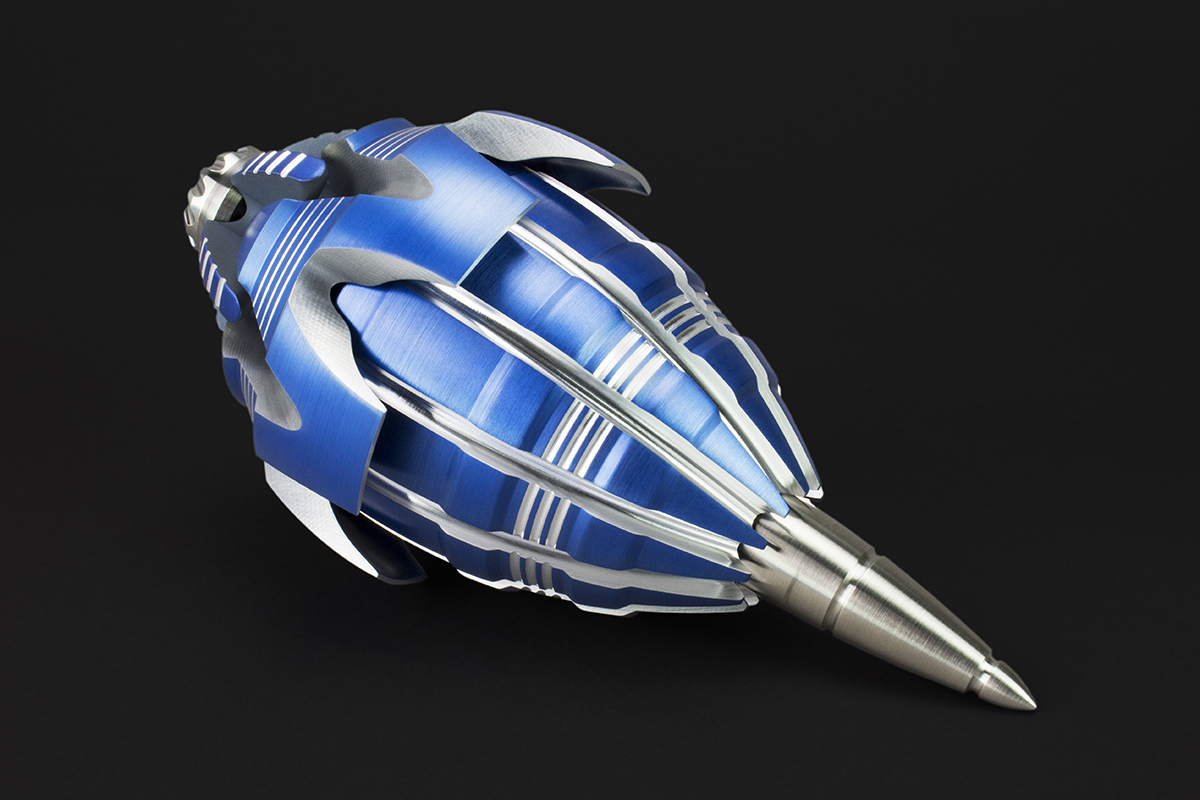
As part of my upcoming exhibition at the National Museum of Industrial History (opening this January) I have been preparing a comprehensive re-issue of my Artist book. It has been nearly three years since it was last updated, so there was gobs of new work to include.
This new soft cover edition is a whopping 264 pages of machined art goodness. It includes a comprehensive chapter dedicated to all of my kinetic and pocket art projects to date. This new section has been handled with extra care, with plenty of exposition to ensure that each kinetic art project retains the necessary context to be appreciated as a bridge between the worlds of fine art, craft, and design.
Unlike previous releases of my book, which were issued through Blurb. This time I am finally (finally!) getting this done the right way. I have partnered with a very enthusiastic local printer to make sure that the print quality is exactly what I want and far superior to anything that has come before it. And because I am getting a sizable print run, the price will be far more affordable than previous printings (just $25 each).
While there will of course be copies on hand at my show this coming January, if any of you want to get your hands on a advanced copy now, I am starting a sign up for early release now.
I will be signing and numbering each of these advanced copies just to make them a bit more special than what the general release will be.
This book has been an ongoing project of mine, and I appreciate all of you for following what I do, it has meant everything to my work and to me, so thank you.
And as always, comments and questions are welcome.
Over the last three years, I have been exploring the ways in which my medium (machine work) intersects with various design and craft traditions.
This work is the third in my series of mechanical vessels, all of which stem from a collection of sketches I made back in 2016. At that time, I began thinking more seriously about how utility plays a key role in various aesthetics within the industrial arts.
Since then a have become involved in a full blown inquiry of how various industrial processes find their way into artistic use, and it has blossomed into a separate thread within my sculpture practice.
This work builds directly on visual and design elements developed during both the NHVB and NV2 projects. A bit larger than both of those pieces, it functions much better as a container without sacrificing what made its predecessors mechanically and visually compelling.
The mechanical action of this work is one that (for better or worse) gives the impression of a claw or a simple grabber. Which is why despite the familiar nomenclature in its formal title ("SMV3") it has already garnered a second semi-official nickname as “The Snatch Vessel”
Early concept sketch from 2016
The origins of this work shed a light on how my own abilities as a sculptor continue to grow. Of the handful of concept sketches I made for mechanical vessels, the early draft of this work was one in which I was least confidant.
While it was an interesting concept, it was one I felt I might not actually be able to build. I knew what the mechanics needed to do, but how to implement them in a way that was elegant and did not interfere visually with the rest of the object seemed quite impossible at the time. Like so many ideas, I set it aside to let it mature.
Experience and time have a way of bringing fresh solutions to old problems. Having now worked on quite a few kinetic art objects since 2016, I was now able to revisit this design and draw on a much larger pool of domain knowledge to finally realize this unique piece.
The mechanics for SMV3 may seem straightforward, but they are deceptively complicated.
On first impression, it looks as though depressing the plunger on the top would simply rotate the locking arms out to the side and allow the lid to be lifted off. But in order for the arms to properly release, they need to be able to swing down under the gripping edge of the container. Also, for the container to have a firm lock, the arms need to be able to swing back down under, and then lift up against that same gripping edge and keep tension, engaging like a hook.
To do that, the pivot point of the five arms needs to be able to shift up and down at the appropriate time.
Three years ago, this was something I just couldn’t work out. My early attempts were too complex, required multiple steps to operate, and generally made it impossible to design an object that wasn’t a mechanical monstrosity.
But again, time and experience can sometimes bring clarity, and now the solution seems deceptively simple.
To achieve this, the lid was made in two parts, an upper and lower half. These halves can slide up and down independent of each other. The lower half of the lid serves three roles. It is what seats onto the lower vessel, sealing it shut. Its geometry also conceals the hinge pin openings on the upper half, preventing their removal. And lastly, it holds a spring that acts against the upper half of the lid, keeping it in tension.
The top half of the lid houses the hinges for the plunger-actuated arms and floats on top of the spring in the lower half. When the plunger on the top is depressed to rotate the arms, it creates enough additional force to also compress the float spring. This allows the upper lid and hinges to drop just a fraction of an inch, allowing the hook-shaped ends of the arms to clear and swing free of the lower vessel so the lid can be removed.
This all works without any extra steps or motion on the part of the operator, and the same goes when replacing the lid while depressing the plunger.
Interestingly, this arrangement also prevents operating the lid (and dropping the vessel) while being held in mid air by the knob alone. The mechanism only works when there is a counter pressure on the bottom of the container, be it a table, your hand, or another resting surface.
Family photo of NHVB, NV2, and the new SMV3
It all works too well really. It is one of those “it is so simple no one will believe it was hard to design” situations. But I don’t care, the piece works great and it looks even better. It fits beautifully into the family of vessels I have made to date and I count it among one of my most elegant technical achievements.
So as has become routine, I am eager to see what insights I can glean from developing and refining the process for making a small run of these works. So a limited edition seems in order.
Unlike the first two vessels, which were collaborations with my good friends over at RevolveMakers, I am going to bring this particular project back in-house and build them in my shop.
Because I will be building these alongside a couple of other projects I am developing, and because they are quite complex, this edition is going to be pretty limited. Probably around 10-15 works total.
Although I only have a prototype in brass and stainless steel at the moment, I will also offer a version in all Stainless steel. I am working on an example of that combination as we speak. But below is an approximation.
Its all silver...Get it :)
So how will this sign up work?
I will open a pre-order sign up on Tuesday of next week (July 2nd at 12 Noon EST).
For the die-hard collectors out there, I will take the first 10 people who get their names on the list.
From there I will make an additional 5 (or so) spots available to the rest of the people who add their names to the sign up, and assign them by doing a random number drawing once the list closes.
I expect the first ten slots to disappear almost immediately so you will have to be very quick if you want to get a guaranteed spot.
I will leave the sign up open all the way through Friday (July 5th). So anyone who feels lucky and wants to throw their name in the hat will have plenty of time to make an informed decision about whether to try and bring one of these beauties into their collection.
So look for a sign up link here (as well as IG and my newsletter) on Tuesday July 2nd, or sign up to my newsletter to have it emailed to you at the proper time.
As always, comments and questions are welcome, and good luck.
Everyone knows I love doing extra credit projects. Well, I wrapped on my MG-2 sculpture project much earlier than I expected, so I couldn't help experimenting with a thought that occurred to me during its production.
Originally, I was using ceramic bearings for both the MG-1 and the MG-2. These bearings are very hard, which is what makes them such good bearings. However, this is not good for some applications and I found that they were not friendly to some of the softer metals I was using. This led me to think there was no way I could use aluminum in conjunction with this mechanical arrangement.
But during development of MG-2, I also started experimenting with Delrin bearings, which are a hard plastic. Turns out, they are just hard enough to work as a bearing, but much softer then ceramic, and to my surprise, much gentler on the races of my MG pieces.
At some point during fabrication of MG-2, I realized that this might open the door to doing a completely anodized aluminum version of the piece, as the Delrin is soft enough not to damage an anodized bearing race, which is something the ceramic bearings would surely do. This would allow a much wider range of colors and all but eliminate the other weight issue I had with the MG-2.
Unfortunately the ship had sailed on MG-2 to try it, but I just couldn’t resist and so here we are with a prototype for what I am calling MG-3.
Functionally it is very close to MG-2 but with a new profile and as you might imagine, the color variations are limited only by the number of dye tanks I have. I like doing things in three’s anyway, so I am going to make this an official release and call it the last of the MG series.
So I am going to open this up to a very small and limited edition. I am going to do a “FLASH SIGN UP!!”
Sounds fancy right!
Basically, I want to limit the number of pieces I am going to make. Rather than a raffle or something like that, I want to try something new. I am going to severely limit the sign up window. I will open a pre-order sign up similar to past sign ups, but the form will only be live for exactly ten minutes. YEP…ONLY TEN MINUTES!
I will open the form at 12Noon EST this Thursday, June the 6th. I will close the form at 12:10 PM. No exceptions and only one work per person.
I am going to open up the color choice completely (something I never do) and allow you to choose any color combination you like, so long as it is a color that I already have set up. Here is the list.
Clear (No dye or raw aluminum look)
Bright Orange
Champaign copper
Deep copper (same dye as above just longer soak)
Green
Teal
Violet (Purple)
Blue (its like a royal blue)
Red (Merlot)
Black
Those are the colors I am working with currently, so you will be able to choose what ever you want for both the bodies and the inlays. I will work this out on the form. Examples of each of these colors can be seen by looking through my catalogues of work on my website.
OK, that’s all for now. I will email the link to my mailing list at 12Noon on Thursday and post it to this blog and Instagram as well. I will close the form AFTER ONLY TEN MINUTES. This is only for the most dedicated collectors among you, so this should be fun.
This work is loosely based on a very common type of automatic knife called an "OTF" or "Out The Front" knife. Sort of like the much more popular switchblade, it is characterized by a spring loaded assembly that extends and retracts the blade through the top of the knife by means of actuating a small lever.
In the case of this kinetic sculpture project, the center object moves both "Out the Front" and "Out the Back". Surely some crazy knife designer has made a knife like this somewhere at some time, but in any case, I am calling this work the "OTFB". The B stands for more than one thing, but I have given you the most obvious one.
The edition saw me experimenting with a wide variety of color and material combinations coupled with small tweaks to the original design. Below is the full catalogue of the entire run.
Red anodized aluminum with black powder coat.
Purple anodized aluminum with black powder coat
Green anodized aluminum with white powder coat
Blue anodized aluminum, re-machined to expose raw aluminum.
Brass with red powder coating
Brass with Black powder coating.
Teal anodized aluminum with yellow powder coating
black anodized aluminum with green powder coating
Deep copper anodized aluminum with blue powder coating
Purple anodized aluminum with blue powder coating
And of course, no edition would be complete without at least one All stainless steel version. In this case, I made a pair of them.
It was a long and fascinating ordeal to produce all of these variations, but all good things must come to a close. ...So that new good things can begin of course.
Earlier this winter, I took a rare month from my normal routine in order to prototype, experiment, and just generally play around with a wider range of ideas than usual. Some of the experiments from this month of tinkering may never see the light of day. But today I have decided to let one of those ideas out of the bag.
Although I suspect some of you might have been expecting this piece, I introduce the MG-2.
For those unfamiliar, please see my earlier post for the MG-1
This piece is a perfect example of how seemingly small changes to a design can create many unforeseen challenges. It is why I so often find myself saying if you don't get your hands dirty from time to time, it is very difficult to be a good artist or designer. That is because I have found over and over again that it is the "work" that leads to "inspiration" and not the other way round.
When I was doing the initial sketches on this piece, I had
some vague idea of how I wanted to iterate on the original
MG1 piece. I knew I wanted it to be longer
and narrower so it would fit in the hand a certain way and I had a rough outline of a shape I liked.
However the first draft I made was quite plain. It was
obvious that something was missing and that the idea just needed more time to
mature, that I needed to just think on it a bit longer. But as long as I
waited and try as I might, I could not “think” of what was missing.
I tried, through sketches, to add a lot of trivial decorative elements, adding notches
and details that had no reason to be there other than to try and make things
“look” a certain way. No matter how many renders I did, I just
couldn’t hit on anything that clicked for me. All of the design decisions I was
making felt arbitrary and unnecessary.
So eventually, after months of this off and on thinking and
sketching, I decided to just“make”
a rough version of what I already had. Just something I could hold in the real
world. Maybe it would speak to me and tell me what it needed.
I had no intention
of this first work being the final form, I just wanted to see what might emerge
from the process of fabricating the parts. Whether the challenges involved in
the physical building of the thing might shake something loose.
I reasoned, as I always do, that there are
some things you just can’t get from staring at a computer screen and rubbing your
chin. And boy was I right in this
case.
For such a simple shape, it turned out to be a particularly
difficult fabrication process. There were an unusually high number of problems that arose during set up
and machining.
They were things that absolutely needed to
be accounted for, and they immediately highlighted the constraints I was working with and helped me focus on the design choices that were most important.
From there, the piece practically designed
itself because I was able to properly weigh the opportunities and costs each of my design choices presented.
So while I was hopelessly stuck in the drawing room, addressing
real issues in the real world quickly led me down a path of necessity that
also proved to be a visually elegant and meaningful aesthetic solution.
If you are interested in the specifics of some of the challenges I encountered, the embedded video above addresses quite a bit of that. Better than me writing a novel about it.
So, as has become customary, a small edition of the MG-2 seems appropriate.
For those interested, I will open a short pre-order for this series on
March 19th, 11 AM EST.
The sign up list will be open for 24 hours Only!
I expect to begin production early April.
So check back at this space in a week and I will post the link to the sign up with all the details and pricing info then.
Today, I am pleased to reveal the second installment in what is becoming a "machined vessel" series.
This design project is yet another collaboration with my friends at Revolvemakers, and has been in the works since the release of our original NHVB Vessel. The idea for this series was spawned by my ongoing interest in how other industrial processes have transitioned from the factory floor into various niche and fine art traditions.
As many of you know, I have been thinking a lot about traditional forms within the various studio craft movements. Practices such as glasswork, woodwork, ceramics and stone are interesting to me because I see connections with their history and the journey I am currently on with machining. Essentially, any craft that got its start as a utilitarian industry, was at some point used to make pots, bowels, and cups. So within each craft, there are long standing traditions of making specific objects, and vessel forms dominate nearly all of them.
Strangely enough, this is something that (for now) seems to make machine work as a craft, just a little bit different.
As the name implies, machining is born of machines for the purpose of making (other) machines. As a craft, it has its roots in steam engines, automobiles, and airplanes, not to mention myriad weapons of war. It is a sprawling discipline that encompasses a wide range of processes and specialties. It is the medium of the industrial revolution, which itself spawned many art movements, but sadly machining, as a creative medium, was largely overlooked.
Because it is such a holistic practice, machining lacks a universal body of shapes and projects that its practitioners would use to learn the ropes. There are some basics, but where the majority of wood turners may make bowls and turned boxes to learn the trade, machinists tend to specialize within the wider medium, and make only what their particular pursuit demands. In this way it is both a broad and narrow medium.
This should come as no surprise to those familiar, as machining was and remains the driver of every conceivable innovation for the last two and a half centuries. At its best, it has put humans on the moon and robots on mars.
So while it may seem counter intuitive to use a technologically complex process to revisit old forms from industrial crafts of yore, it is important to remember that each craft, no matter how old, was cutting edge technology at some point in time. The impulse to formally explore technologies is often very similar regardless of its vintage.
You can see how this dynamic of blending old and new technology has played out in the knife making community.
What started out as a Blacksmith's domain, has now been utterly dominated by the world of machining. It is a perfect example of an artisanal craft being augmented and improved upon by new technology in lots of interesting ways. It has spawned many new niches within the knife making and machining community, as well as insured there is enough interest in knife making as a whole to preserve first hand knowledge of some of the more historical aspects of the craft.
An act of appropriation, is quite often, also an act of preservation.
I think this vessel project is another great way to demonstrate what is similar across disciplines, as well as what is so distinctive about my particular medium of choice.
Subtext now firmly out of the way, to the specifics of this piece. While my first project (The NHVB) was sort of a multi layered journey into urns, beads, snuff bottles, and Japanese Netsuke/Sagemono, this new work is a bit of a broader stroke as far as the specifics of it being a vessel.
Derived from the same series of small mechanical urns as NHVB, my starting point was to design a sort of snuffbox. But this time I tried not to muddy the water with too many ideas as I wanted to give this thing room to grow organically and just generally work exceedingly well. I wanted a great mechanical piece that could speak to both sides of the sculpture/craft coin that is a growing theme in all of my work.
This work is good deal larger than NHVB, which makes it a more versatile container. However, the mechanics of the object are quite intricate, if maybe a little less showy than its predecessor. This makes the build a much more intensive undertaking.
The sixteen cross-pins on this piece serve as latches. The cross-pins are actuated by screwing the knob on the lid, down onto a pressure plate. This pressure plate acts on four bronze keys with wedge profiles cut into them. These keys slide down a channel and act on small cam shapes cut into the backs of each of the sixteen cross-pins that secure the lid.
It takes good deal of force to move that many spring loaded pins, so while the action is sort of a slow moving screw action, it is an elegant mechanism and provides a robust locking action. It really is a visually and mechanically fascinating piece.
We have also worked in an optional O ring seal for a perfect air tight fit. This makes the lid extra snug (which is why it is optional), but it is, after all, a Snuff Box.
How can I get one?
This work, like the NHVB, is being produced in a limited edition as part of my ongoing collaboration with my friends at Revolvemakers in Virginia.
Unlike previous projects however, a fair number of these works are already nearly complete and will be ready to ship within a week or so! We did this because we had a number of unexpected delays on last years projects. This time, in order to account for any unforeseen bumps in the road, we decided to be extra careful and make sure everything was perfect and ready to go before even announcing these works.
All of the parts for the first few dozen of these are already machined and are being polished and assembled as we speak.
We will be posting a sign up sale on Tuesday (February 5th) of next week to place the first two dozen of these. I will post details as soon as they are finalized.
Until then please enjoy the pictures, and comments and questions are always welcome.